
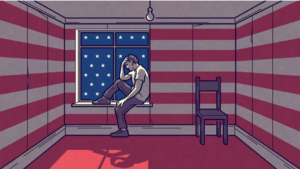
HOW DID AMERICA’S LONELINESS EPIDEMIC COME ABOUT?
Humans have always been social creatures. From early nomads, to settlers, to empires, to dynasties, and to the most complex civilizations, people have relied on each other as a means of survival. According to the article, “The epidemic of loneliness”, published by eClinicalMedicine, “Earlier in human evolution it was far more dangerous to be alone and community provided safety as well as shared resources, therefore, avoiding being alone had an evolutionary advantage and shapes our behaviour to this day” (eClinicalMedicine, 2023). And this holds true when examining many examples throughout history: hunter-gatherers would travel in groups. Before cities or kingdoms ever emerged, families in tribes raised children, domesticated animals, and shared resources together. In the formation of empires, people discovered land and water routes, linking them from one region to another; this served only to increase human connections as goods, as well as ideas about values, religion, science, technology, and culture spread.
Then fast forward to 2020, COVID-19 came and more specifically, when the U.S. underwent lockdown, feelings of isolation began to increase among Americans: in his review of psychiatrist Fromm-Reichmann’s 1990 article, “Loneliness”, author Andrew Bland writes, “Last year, the Office of the U.S. Surgeon General (2023) declared loneliness a public health crisis… historically it has been associated mostly with older adults. However, in the aftermath of the COVID pandemic, for the first time, younger people are lonelier and, concurrently, experiencing more mental health issues” (Bland, 2024). It seems for a nation that should have been brought closer from surviving this traumatic event, its society rather drifts further apart. But why? When exploring the impact of the pandemic on the current U.S. loneliness epidemic, factors such as a lack of a sense of community and the rise of technological advancement, along with hyper capitalism and a “work-first culture” lead to greater alienation (Bland, 2023).
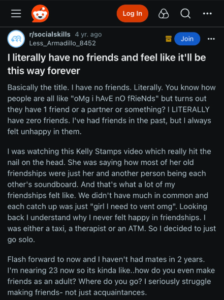
Hyper Capitalism + Work-centered Culture
American living has become so fast paced and money driven that people are required to sacrifice connection with each other, “…in striving to stay afloat and get ahead, Americans tend to neglect relationships” (Bland, 2024). For example, during the COVID-19 lockdown, many were working from home and automatically, the dynamics and face-to-face interactions that were once fostered by the office setting had been stripped away. This is when many seized the opportunity to start their own businesses or become influencers, thereby, further removing themselves from the traditional workforce.
On the other side of the spectrum, you have essential workers and vulnerable groups who were forced to go into work, some having to balance multiple jobs due to financial pressures. In doing so, not only was contact limited between them and those they worked with as well (via the 6ft distance rule), but they also had less opportunities to spend time with family and friends.
Additionally, Bland mentions an interesting phenomenon discussed “…in The Lonely American, Olds and Schwartz (2009) identified a collective pathology whereby people stay busy (experiential avoidance) to avoid seeming lonely but ultimately feel lonelier because they have inadequate time to maintain relationships” (Bland, 2024). We can now reckon that back in the midst of lockdown, people were grappling with a need for intimacy and connection that couldn’t be met due to a virus that mandated containment and social distancing; so those same people turned to materialism and consumption to fill in those gaps and occupy their time instead.
By this point, Americans are witnessing the “…breakdown of local communities supplanted by corporations and online shopping…” (Bland, 2024). Corporations have misled people to think they need the latest product or service in order to relate to the next person. Business brands have disturbingly morphed into personal identities. Social media apps and their curated feeds have sadly come to know people better than their own loved ones. These things only serve to rub more salt on the wound that is American loneliness.
Lack of Community + Tech Advances:
It appears that as Americans progress towards technological development and an advanced digital age, “…a ‘corroding feeling of estrangement’ accompanies [this] ubiquitous automation…” (Bland, 2024). Our modern tools have made everything convenient. But perhaps too convenient?: With the advent of delivery apps people can skip going to the store, and subsequently, dealing with employees or other customers. The hospitality industry has ironically made people hyper independent because why bother having a friend pick you up from the airport and spend a holiday with them, when you can call an uber and rent an expensive airbnb with instagram worthy pictures.
Streaming services allow people to miss out on the whole movie theater experience; and with almost all films being uploaded to these platforms, what’s the point of paying almost $20 for a ticket to see one movie–and another twenty for some popcorn and a large drink–when you could have a library of TV shows and movies at a smaller cost. In regards to the lockdown, in exchange for what was initially safety, but after became convenience, we had traded in a lot of our third spaces. That is, public spaces that weren’t school or work, where we could simply relax and enjoy each other’s company, aren’t so common anymore.
Post Pandemic Alienation:
Essentially, “As individuals retreat further into their silos, whereas being neighborly used to mean visiting people, now it means not bothering them. Accordingly, authentic encounters slip into transactional ones” (Bland, 2024). It appears that community, previously an evolutionary advantage, now is just too inconvenient for people, resulting in our current post pandemic alienation.
References
Bland, A. M. (2024). Fromm-Reichmann’s (1959/1990) Real Loneliness in the Contemporary United States. The Journal of Humanistic Psychology. https://doi.org/10.1177/00221678241266372
eClinicalMedicine. (2023). The epidemic of loneliness. EClinicalMedicine, 66, 102395–102395. https://doi.org/10.1016/j.eclinm.2023.102395

This entry is licensed under a Creative Commons Attribution-NonCommercial-ShareAlike 4.0 International license.

